
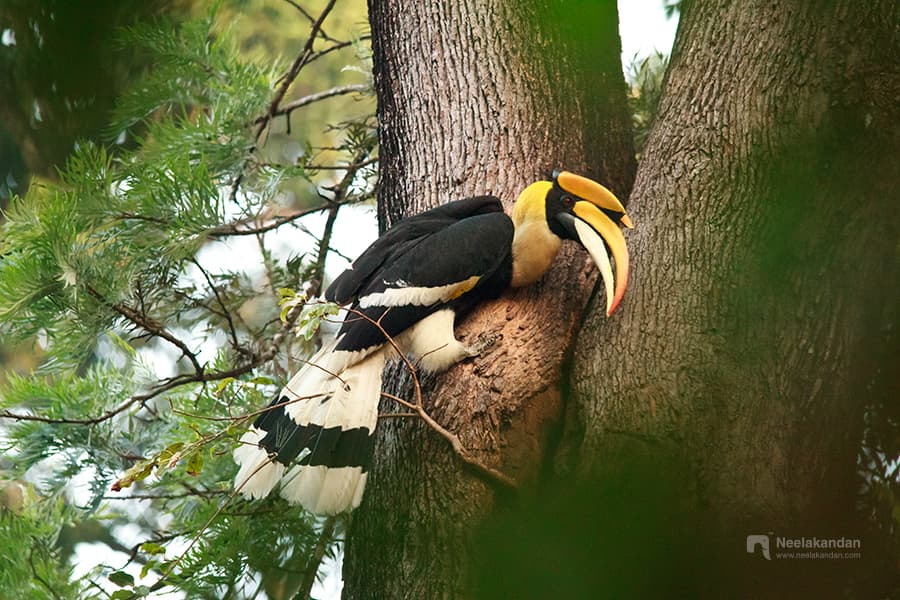
Great Indian Hornbill · Forest Health · Western Ghats Wildlife · Wildlife Conservation
The Great Indian Hornbill and the Truth About Forest Health
1 January 2014
Some birds belong to a landscape so completely that their presence says more about the place than any checklist ever can. The Great Indian Hornbill is one of them. It does not merely live in a forest. It reveals the condition of the forest itself.
In the Western Ghats, the sight of a Great Indian Hornbill is never small. The sweep of its wings, the force of its flight, the weight of its bill, the strange authority of its silhouette against the canopy, everything about it feels ancient. It is easy to admire the bird for its size and grandeur. That is the obvious part. What matters more is what the bird is quietly telling us about the forest below. The species is closely associated with large tracts of relatively undisturbed forest, and it remains globally listed as Vulnerable.
A forest may still appear green from a distance and yet be ecologically weakened. That is the deception people often fall for. Green is not the same as healthy. A plantation can look green. A fragmented hillside can look green. A forest emptied of old trees can still look green. But the Great Indian Hornbill does not respond to this superficial version of forest. It depends on something deeper—mature trees, canopy continuity, fruiting networks, and enough ecological stability for breeding and movement. Where hornbills endure, forest quality usually endures with them.
This is one of the reasons the bird matters so much. The Great Indian Hornbill is not simply a resident of old forests; it is a species that depends on large nesting cavities in mature trees. During breeding, the female seals herself inside a tree cavity, and the male sustains her and the chicks by delivering food through a narrow slit. That is a remarkable adaptation, but it is also a ruthless ecological filter. It means the species can only breed where old trees still exist and where the surrounding forest remains productive enough to support that long and fragile cycle. Remove the veteran trees, and the forest may remain standing in appearance while becoming unfit for hornbills in reality.
The Great Indian Hornbill also tells us something about the future of a forest. Hornbills are among the most important seed dispersers in Asian tropical forests. They feed heavily on fruits and carry seeds across long distances, helping forests regenerate beyond the shadow of the parent tree. This is not a decorative ecological role. It is structural. Hornbills help shape the next forest. When large fruiting trees depend on large birds for dispersal, the disappearance of those birds eventually alters what the forest can become.
That is why the decline of hornbills is never only about hornbills. It signals a wider unraveling. When hunting increases, when old-growth trees are logged, when forests are broken into smaller and more isolated fragments, hornbill populations weaken. And when hornbills weaken, seed dispersal weakens with them. The damage is not always immediate to the human eye. Forests often lose function long before they lose visual cover. By the time the absence becomes obvious, the decline has already settled into the system.
There is something especially revealing about the Great Indian Hornbill in the Western Ghats because it lives at the intersection of beauty and ecological seriousness. It is spectacular enough to attract attention, but its survival depends on conditions that are increasingly hard to maintain: connected forest landscapes, reduced disturbance, nesting trees of real age, and a canopy that still produces food through the seasons. It is a bird that forces honesty. If a forest can no longer support hornbills, then something important has already been lost, whether or not the loss is visible in a photograph.
This is why the hornbill should not be understood only as an object of admiration, or even only as a subject for wildlife photography. It is better understood as a measure. It tells us whether a forest still retains its depth. It tells us whether the old architecture of the landscape still stands. It tells us whether fruiting trees, nesting trees and movement corridors still exist in meaningful continuity. And because it helps regenerate the forest it inhabits, it tells us whether the forest still has a future larger than its present.
In that sense, the Great Indian Hornbill is not merely a bird of the canopy. It is one of the clearest voices a forest has. Not loud, not direct, not theatrical—but unmistakable. When hornbills continue to fly across a landscape, the forest is still functioning in ways that matter. When they begin to disappear, the silence means more than the loss of a species. It means the forest is beginning to forget how to remain a forest.